Count your re-entries: the audit to run on your last feature
Max Barbet6 min
Forty minutes will give you three numbers: how many times the same information was retyped in your chain, at which exact step it began to degrade, and how many people touched it without deciding anything. The third one is the one that works in a prioritisation discussion.
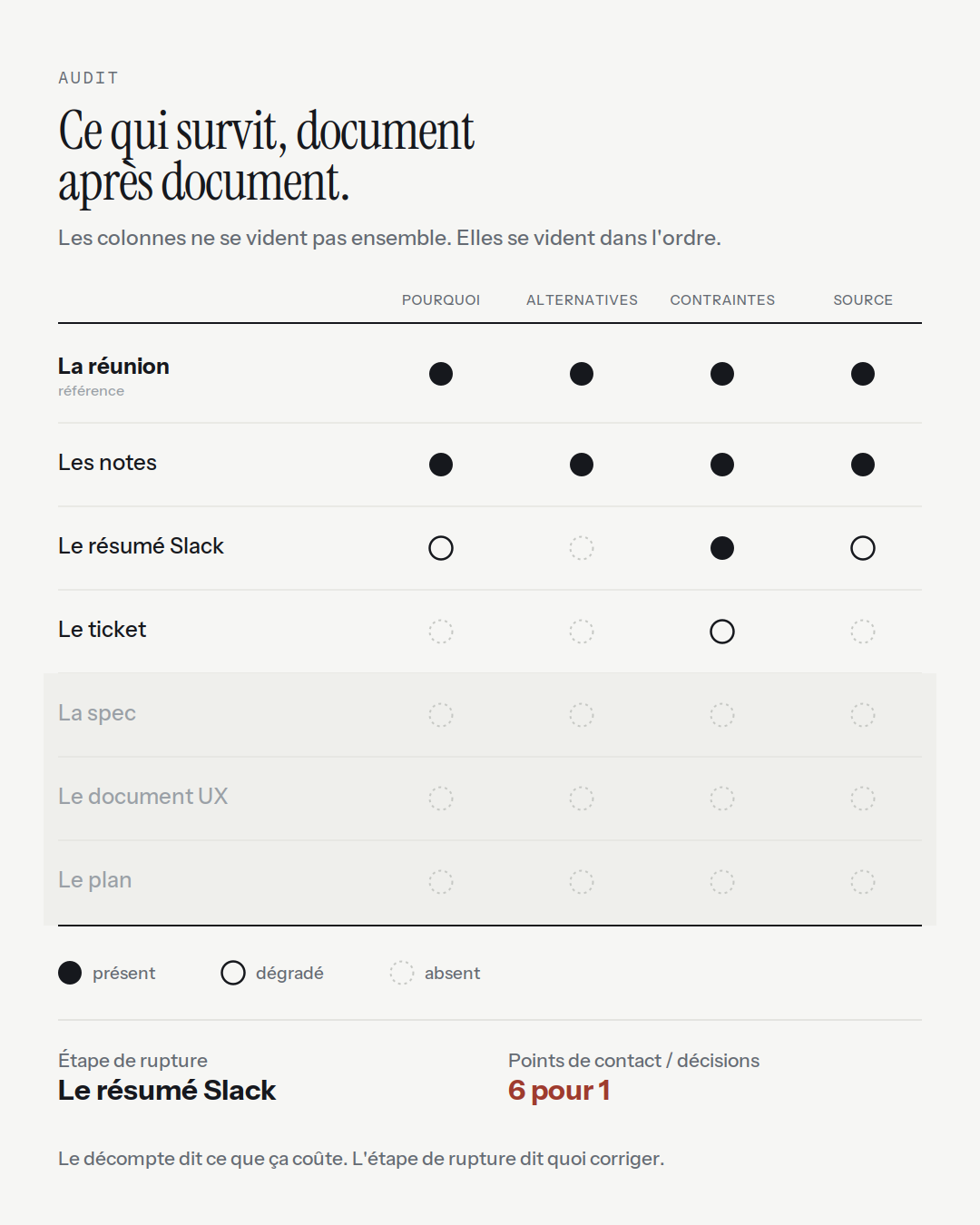
The five-question protocol. The table to fill in. What the three numbers mean once you have them.
Before you start: which direction
Take a feature shipped recently, a small one for preference. Start from the meeting where it was decided and walk forward to the ticket. Not the other way round.
It is the one point of method that really matters. Walking back from the ticket gives you the right number of passages, but it misses everything that vanished without leaving a trace downstream — and that is precisely what the audit is looking for. A constraint stated in the meeting and never written down anywhere is invisible if you start from the end. It is obvious if you start from the beginning.
You need two things: the record of the original meeting, and the run of documents produced after it. Notes, Slack message, ticket, spec, mockup, plan. Line them up side by side in chronological order.
The protocol: five questions per passage
A passage is the moment one document produces another. Notes to Slack summary, summary to ticket, and so on. Ask the same five questions at every passage.
Was this document written from the meeting, or from the previous document?
If it was the previous document, count one re-entry. This is the only question that feeds the count; the other four are for something else.
The answer is almost always “the previous document”. Nobody reopens a forty-minute transcript to write a ticket.
Is the reason for the decision still written here?
Three possible answers: present, degraded, absent. Degraded means a trace is left but it would not be enough for somebody who was not in the room.
Are the discarded options here, with the reason they were discarded?
Same scale. Without the reason, a discarded option counts as absent: it will be proposed again.
Are all the constraints stated in the meeting present?
This one requires rereading the meeting, not only the documents. It is the longest of the five and the most profitable.
Can you trace a sentence in this document back to the sentence in the meeting that produced it?
In practice: is there a source, a timestamp, an excerpt? If the answer is “we could ask somebody”, it is no.
The table
One row per document, four columns for the four elements. Fill it in with three marks: present, degraded, absent.
| Document | Why | Alternatives | Constraints | Source |
|---|---|---|---|---|
| The meeting | present | present | present | present |
| The notes | — | — | — | — |
| The Slack summary | — | — | — | — |
| The ticket | — | — | — | — |
| The spec | — | — | — | — |
| The UX document | — | — | — | — |
| The plan | — | — | — | — |
The first row is your baseline: by definition, everything is present in the meeting. The rest of the table measures the gap from it.
What you will see appear is a diagonal. The columns do not empty at the same time, they empty in an order, and that order is almost always the same.
The five questions as entry help, dots that step down one notch per click, and the three numbers computed for you. Nothing to install, nothing left behind.
Your three numbers
The number of re-entries
The total of “from the previous document” answers to the first question.
The breaking step
The first document where a column turns to “absent”. It is the most useful of the three and nobody computes it.
The ratio
The number of people who touched the information, divided by the number of decisions actually taken. For most features the denominator is 1.
What the numbers mean
The count
Between three and five, you are in the normal range for a team that writes its specs. Below three, either the team is very small, or you have forgotten an informal passage — the voice note, the corridor conversation reworded into the ticket.
Above six, the chain has more than one owner. That is not a problem of individual rigour, it is a problem of division: each person adds a document because they do not trust the format of the previous one.
The breaking step, which matters more
The count tells you what it costs. The breaking step tells you what to fix, and the two common cases call for completely different things.
A break at the first passage, between the meeting and the notes. Your problem is capture. What was said never entered the system, so no downstream tool can recover it. It is the most frequent case and the easiest to fix.
A break at the third or fourth passage, between the ticket and the spec. Your capture is good, but nobody goes back to the source any more. The information exists; it has simply become unreachable because everyone works on the document the previous person handed them.
These are two different failures. Fixing the first when you suffer from the second changes nothing, and it is the mistake I see most often: buying a meeting-notes tool when the failure is really three steps further down.
The ratio, the one that works in a prioritisation meeting
The re-entry count is an engineer’s number: it interests the people who live with the chain. The ratio is a leadership number.
“Six people touched this information, one decision was taken.”
That sentence needs no context, and it compares from one team to the next. It is the phrasing that gets a budget or a slot, not “we are losing time on documentation”.
Three cautions
A feature is not a process
You are measuring one case, not your organisation. Do three, of different sizes, before concluding anything at all. If all three give the same breaking step, you have something.
Do not count reviews
Somebody who reads and comments is not re-entering. That is value-adding work and it is not what we are looking for.
Do not show the filled-in table to the people who appear in it
Not straight away, at any rate. The table looks like an individual performance review when what it measures is an architecture. Present the three numbers; keep the detail to yourself.
And then
If you do the exercise, the next question arrives on its own: which of these passages can be removed?
None of the four elements you have just tracked is lost through carelessness. They are lost because every passage is a rewrite by hand, and a rewrite discards by construction. That is the subject of the previous article, which explains why a better document template changes nothing.
Tell me your three numbers.